

About the course
Professionals working in energy regulation make decisions every day that depend on how the power system works. Yet many regulators, policymakers, lawyers, economists, financial analysts, and managers have not received formal engineering training. This can make it difficult to assess questions related to system reliability, service quality, network investment, electricity losses, tariffs, billing, emerging technologies, and consumer protection.
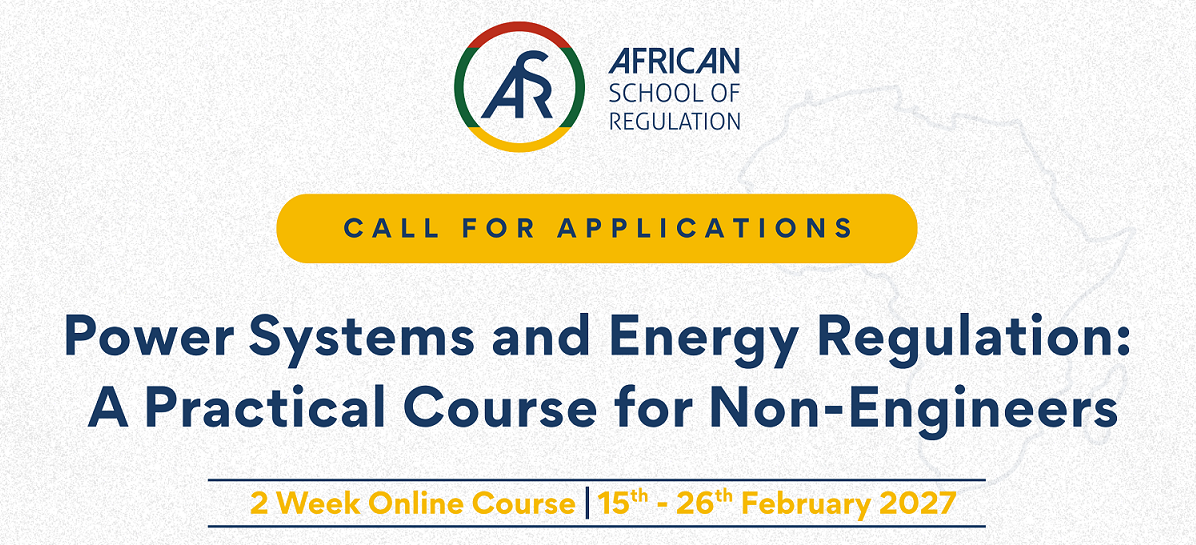
Power Systems and Energy Regulation: A Practical Course for Non-Engineers is a two-week online course developed by the African School of Regulation to make the technical foundations of the electricity sector accessible to non-engineering professionals. It follows electricity across the full value chain from generation and transmission to system operation, distribution, metering, billing, and final consumption and connects each technical concept directly to regulatory and policy decisions.
The course avoids unnecessary mathematical detail. Through clear explanations, diagrams, practical examples, guided discussions, and applied exercises, participants will build the confidence to understand technical language, interpret information from engineers and utilities, ask better questions and contribute more effectively to decisions affecting power-sector performance and consumers.
Course Highlight
Learn how the physical operation of the electricity system shapes costs, tariffs, reliability, utility performance, service quality and consumer outcomes. The aim is not to turn participants into power-system engineers but to give them the practical technical literacy required to work confidently across engineering, economic, commercial and regulatory teams.
What You Will Learn
- How electricity is produced, transported, balanced, distributed, and consumed across the power system value chain.
- The principles that support safe, secure and reliable power-system operation.
- How common faults, outages, electricity losses and power-quality problems occur and how regulators can respond.
- How electricity metering and billing work, including the causes of common customer and revenue-protection challenges.
- How technical and operational conditions influence utility costs, revenue requirements, tariff structures and consumer bills.
- How regulation balances reliability, efficiency, affordability, investment, financial sustainability, and consumer protection.
- How renewable energy, distributed generation, battery storage, mini-grids, demand response and prosumers are changing the power system.
Course Structure
Module 1 – Understanding Electricity and the Power System Value Chain
Build a practical foundation in power, energy, voltage, current, and frequency; understand the principal generation technologies; and trace how electricity moves through generation, transmission, system operation, and distribution to the final consumer. The module also introduces generation capacity, energy production, load patterns, peak demand, load curves, and the technical and commercial relationships across the supply chain.
Module 2 – Generation, Transmission, and Real-Time Power System Operation
Examine how conventional and renewable plants operate, how generation is scheduled, and how the system is balanced in real time. Topics include generation mix and costs, economic dispatch, transmission networks, substations, transformers, interconnections, electrical losses, regional power pools, frequency and voltage control, operating reserves, ancillary services, system constraints, adequacy, and contingencies.
Module 3 – Electricity Distribution Networks Faults, Protection Losses, and Quality of Supply
Understand the structure and operation of distribution networks and how technical performance affects the customer experience. The module covers feeders, transformers, switchgear, customer connections, urban and rural networks, common faults, planned and unplanned outages, protection and restoration, reliability indicators, voltage variations, harmonics, flicker, and the causes and regulatory treatment of technical and non-technical losses.
Module 4 – Electricity Metering Billing and the Customer Interface
Explore the connection between the physical delivery of electricity and the commercial relationship between utilities and customers. Topics include metering principles, meter types, credit and prepayment systems, smart meters, accuracy and testing, meter reading and communication, tampering and bypass, customer complaints, revenue collection, commercial losses, and regulatory oversight of billing and customer service.
Module 5 – Electricity Costs, Tariffs, and Network Regulation
Connect the engineering system to its economic and financial consequences. Participants will examine capital and operating costs, utility revenue requirements, cost recovery, cost-of-service principles, tariff structures, customer categories, cross-subsidies, and affordability. The module also considers how demand patterns, losses, network performance, efficiency incentives, and quality-of-service requirements influence costs and tariffs.
Module 6 – Energy Regulation and the Changing Power System
Bring the technical, commercial, and economic concepts together through a regulatory lens. The module covers licensing, tariffs, investment, performance monitoring, quality of service, and consumer protection, alongside the implications of variable renewable energy, distributed generation, mini-grids, battery storage, demand response, prosumers, and two-way power flows. Participants will consider how regulation can enable innovation while protecting consumers and system reliability.
Course Delivery
- Two-week online course delivered from 15 to 26 February 2027.
- Six live online sessions, with three two-hour sessions each week.
- Accessible explanations supported by diagrams, practical examples, guided discussions, and applied exercises.
- Delivered in English.
Assessment and Certification
Learning will be reinforced through short quizzes linked to the six live modules. The quizzes will assess conceptual understanding rather than mathematical ability. Participants who complete the required learning activities and satisfy the course requirements will receive a certificate of completion from the African School of Regulation.
Target Audience
This course is designed for professionals who need a practical understanding of power systems in their work, including:
- Staff of energy regulatory authorities and government ministries
- Professionals working in utilities, system operators, and rural electrification agencies
- Lawyers, economists, financial analysts, policy specialists, and managers
- Development partners, researchers, consultants, and civil-society organisations
- Other non-engineering professionals working across the energy sector