

Programme Highlight
Participants will move from understanding gas markets to applying practical tools for market-readiness assessment, pipeline tariff design, third-party access, gas-to-power contracting, risk allocation, regional trade and transition-ready regulation in African contexts.
About the course
Africa’s natural gas opportunities span new production, domestic gas-to-power, liquefied natural gas (LNG) imports and cross-border infrastructure. However, development outcomes depend on credible rules for network access, pricing, investment protection, contracting, safety and environmental performance.
Regulatory capacity is often fragmented and outpaced by the sector’s commercial and technical complexity. Natural Gas Markets and Regulatory Frameworks in Africa addresses this gap by combining international regulatory practice with African market realities and direct engagement with gas-sector institutions and practitioners.
The course equips regulators, policymakers and energy-sector professionals with practical knowledge to assess market arrangements, evaluate regulatory options and address challenges across the natural gas value chain.
Course Structure
- Module 1 Natural Gas Market Design Structure and Value Chain: Analyse upstream, midstream and downstream market structures, infrastructure constraints and alternative models for organising natural gas markets.
- Module 2 Gas Transmission Regulation and Third Party Access: Explore gas transmission regulation, pipeline tariff design, third-party access rules, capacity allocation, congestion management and access disputes.
- Module 3 Gas to Power Contracts and Risk Allocation: Examine the alignment of gas supply, transportation and power purchase agreements, including the allocation of price, force majeure and change-of-law risks across the contractual chain.
- Module 4 Investment Frameworks and Project Bankability: Assess how regulatory frameworks, contractual arrangements and risk allocation influence investment decisions and the bankability of natural gas projects.
- Module 5 Gas Pricing Fiscal Regimes and Government Take: Compare netback, cost-plus and market-based pricing approaches, and examine fiscal arrangements and their implications for government revenues and investment.
- Module 6 Safety Technical Standards and Environmental Compliance: Examine the regulatory requirements governing safety, technical performance and environmental compliance across the natural gas value chain.
- Module 7 Legal and Institutional Frameworks for Gas Regulation: Explore the legal foundations, institutional responsibilities and regulatory arrangements that support effective oversight of natural gas markets.
Course Highlights
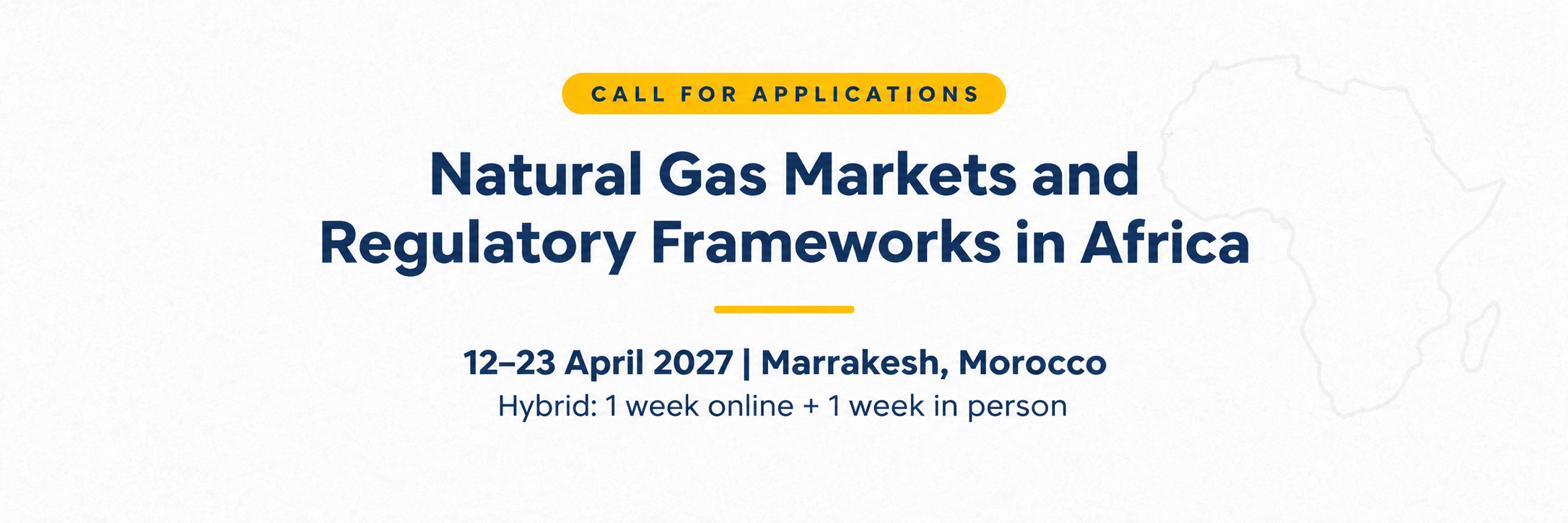
Hybrid Learning. Combine one week of live online learning with one week of in-person training in Marrakech, Morocco. The course will be delivered in English and French.
Practical Exercises and Simulations. Apply course concepts to questions of market design, transmission access, pricing, contracting and risk allocation through practical exercises and simulations.
African Case Studies. Examine regulatory challenges and market developments in African contexts, connecting international experience with national and regional priorities.
Site Visits and Practitioner Engagement. Connect classroom learning with practice through site visits and engagement with gas-sector institutions and practitioners.
Peer Learning. Exchange experience with regulators, policymakers, utilities and other energy-sector professionals from across Africa.
Target Audience
This course is designed for:
- Energy regulators and government officials.
- Professionals from national oil and gas companies.
- Utility and private-sector professionals.
- Financial institutions and development partners.
- Researchers, consultants and university professionals.
Course Fees
| Fee category | Amount |
| Standard fee | USD 1,850 |
| ASR alumni fee | USD 1,406 (24% Discount) |
The fee includes tuition, course materials, site visits and a Certificate of Participation, subject to attendance and engagement. Travel, accommodation, per diem and visa costs are excluded.
Course Resources
Course brochure:
For further information, contact support@africanschoolregulation.org.