
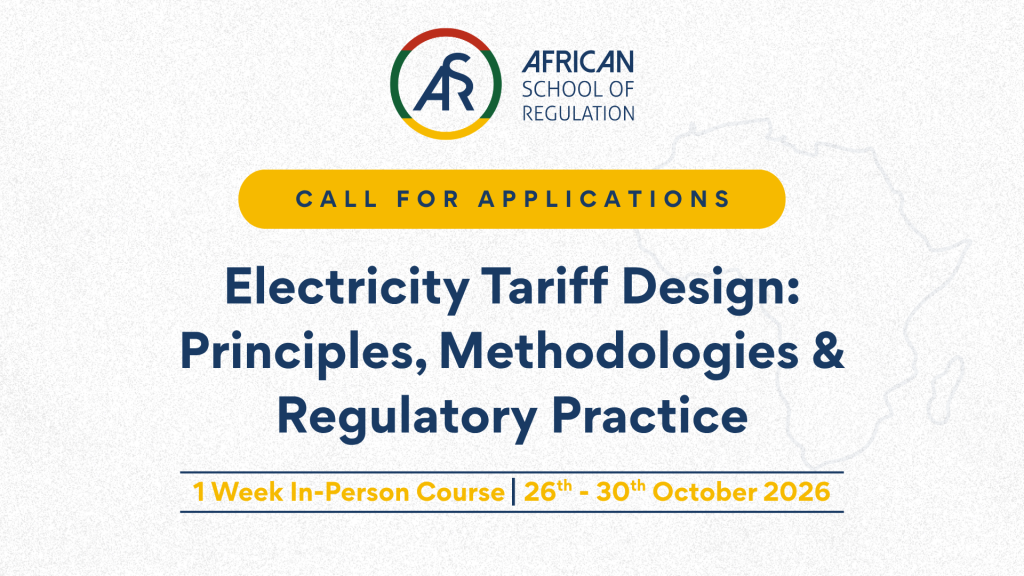
Design Fair, Efficient and Sustainable Electricity Tariffs for Africa’s Evolving Power Sector 5-Day Executive Programme
📍 Accra, Ghana | 🌍 English & French | 📅 26–30 October 2026
About the Course
Electricity tariffs are among the most important tools available to regulators. They influence utility financial sustainability, consumer affordability, investment decisions, and the pace of energy sector reform. As African electricity systems become increasingly complex with renewable energy integration, distributed energy resources, decentralised generation, and evolving market structures, regulators require advanced expertise in tariff design and regulation.
The Electricity Tariff Design: Principles, Methodologies & Regulatory Practice programme is an intensive executive course developed by the African School of Regulation (ASR) to equip regulators, utility professionals, policymakers, and energy practitioners with the practical knowledge and analytical tools required to design, evaluate, and implement effective electricity tariffs in both regulated and competitive market environments.
Combining international best practice with African case studies, practical exercises, financial modelling, and peer learning, the programme prepares participants to develop tariff frameworks that balance cost recovery, affordability, efficiency, and long-term sector sustainability.
Course Structure
Module 1 – Costs, Prices and Charges
Understand how electricity supply is regulated, the relationship between costs, prices, and charges, and the principles that guide their allocation across customer categories.
Module 2 – Determining the Revenue Requirement
Learn how costs arise throughout the electricity supply chain and how revenue requirements are determined under both monopolistic and competitive market environments.
Module 3 – End-Customer Tariff Design
Explore how utility costs are translated into customer tariffs while balancing affordability, efficiency, fairness, and financial sustainability.
Module 4 – Performance-Based Regulation and Distributed Energy Resources
Examine incentive regulation, performance targets, the RPI-X framework, and the implications of distributed energy resources on tariff design.
Module 5 – Special Cases and Practical Tariff Simulation
Address complex tariff issues such as cross-subsidisation, grid defection, and affordability through practical case studies and an Excel-based tariff simulation exercise.
Target Audience
This course is designed for:
- Commissioners and senior staff of electricity regulatory authorities
- Tariff economists and regulatory specialists
- Utility executives and technical managers
- Economists, engineers, and financial analysts
- Energy ministry officials
- Consultants supporting electricity sector reform
- Development partners and donor organisations
- Researchers and academics working in energy regulation
Fees & Cancellation Policy
Standard Fee: USD $1,850
ASR Alumni Discount: USD $1,500
All payments must be completed by 30th September 2026.
Cancellation: The paid registration fee is non-refundable. However, registrant substitution may be made up to 20 days before the course’s start date.
Course Faculty
Course Director
Prof. Ignacio Pérez-Arriaga: Professor Emeritus, Massachusetts Institute of Technology (MIT); Founder and Academic Director, African School of Regulation.
Course Lead
Crispin Berteyeb: Research Analyst- African School of Regulation
Additional faculty members from leading regulatory institutions, universities, utilities, and industry will be announced soon.
Course Resources
Course Brochure: Download